Product Description
Flexible Coupling Rubber Spider Insert Lovejoy L-type Hydraulic Jaw Coupler L series jaw type flexible coupling
Features
1. Split in half design for simple installation, maintaining free
2. High misalignment capacity
3. Facility protection for a twirl, twist, impact, and abrasion
4. No lubrication for polyurethane flex element
5. Available for bore-to-size hubs and taper lock bushes
6. Low noise
Product Description
|
Size |
Type |
A |
B |
D |
E |
Standard |
Metric bore |
Inch bore |
||
|
bore |
Min |
Max |
Min |
Max |
||||||
| L035 |
1 |
16 |
20.5 |
6.6 |
/ |
3 |
3 |
8 |
1/8″ |
3/8″ |
|
L050 |
1 |
28 |
43.2 |
15.6 |
/ |
6 |
6 |
15 |
3/16″ |
5/8″ |
|
L070 |
1 |
35 |
50.8 |
19 |
/ |
9 |
9 |
19 |
3/16″ |
3/4″ |
|
L075 |
1 |
45 |
54.7 |
21 |
/ |
9 |
9 |
25 |
3/16″ |
1″ |
|
L090 |
1 |
54 |
54.7 |
21 |
/ |
9 |
9 |
28 |
3/16″ |
1 1/8″ |
|
L095 |
1 |
54 |
63.7 |
25.5 |
/ |
9 |
9 |
28 |
3/8″ |
1 1/8″ |
|
L099 |
1 |
64.5 |
72.5 |
27 |
/ |
12 |
12 |
35 |
7/16″ |
1 3/8″ |
|
L100 |
1 |
64.5 |
88.5 |
35 |
/ |
12 |
12 |
35 |
7/16″ |
1 3/8″ |
|
L110 |
1 |
85 |
108 |
43 |
/ |
15 |
15 |
48 |
1/2″ |
1 7/8″ |
|
L150 |
1 |
96 |
115.4 |
45 |
/ |
15 |
15 |
48 |
5/8″ |
1 7/8″ |
|
L190 |
2 |
115 |
133.4 |
54 |
101.6 |
19 |
19 |
55 |
5/8″ |
2 1/4″ |
|
L225 |
2 |
127 |
153.4 |
64 |
108 |
19 |
19 |
65 |
3/4″ |
2 5/8″ |
Related Products
Company Profile
FAQ
Q: How to ship to us?
A: It is available by air, by sea, or by train.
Q: How to pay the money?
A: T/T and L/C are preferred, with different currencies, including USD, EUR, RMB, etc.
Q: How can I know if the product is suitable for me?
A: >1ST confirm drawing and specification >2nd test sample >3rd start mass production.
Q: Can I come to your company to visit?
A: Yes, you are welcome to visit us at any time.
/* January 22, 2571 19:08:37 */!function(){function s(e,r){var a,o={};try{e&&e.split(“,”).forEach(function(e,t){e&&(a=e.match(/(.*?):(.*)$/))&&1
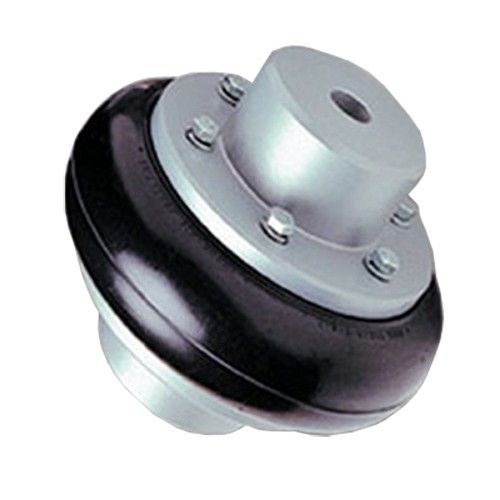
Minimizing Resonance and Improving Machinery Performance with Rubber Couplings
A rubber coupling can play a significant role in minimizing resonance and enhancing the overall performance of machinery by effectively damping vibrations and reducing the risk of resonance-related issues. Resonance is a phenomenon where a mechanical system’s natural frequency matches the frequency of external vibrations, leading to amplified oscillations and potential damage.
The following ways illustrate how rubber couplings contribute to minimizing resonance and improving machinery performance:
- Vibration Damping: Rubber couplings utilize the inherent damping properties of elastomers to absorb and dissipate vibrations generated during operation. These vibrations can include those caused by unbalanced loads, eccentricities, or other disturbances. By damping these vibrations, rubber couplings prevent them from building up and causing resonance.
- Vibration Isolation: Rubber couplings act as isolators by decoupling the connected components from each other. This isolation prevents vibrations from being transmitted directly from one component to another, thereby reducing the potential for resonance to occur.
- Misalignment Compensation: Rubber couplings can accommodate misalignments between shafts, which often contribute to excessive vibrations. By allowing a certain degree of misalignment, the coupling prevents additional forces that could trigger resonance.
- Reduced Stiffness: The flexibility of the elastomer elements in rubber couplings can reduce the overall stiffness of the system. A lower stiffness helps avoid the amplification of resonance by allowing some deformation of the coupling under varying loads and conditions.
- Dynamic Absorption: Rubber couplings are effective at absorbing dynamic loads, including sudden shocks or impacts. These dynamic events can excite resonance, and the coupling’s ability to absorb and disperse such forces helps prevent resonance-related issues.
By effectively dampening vibrations, isolating components, and accommodating misalignments, rubber couplings can help minimize the risk of resonance-related problems. Engineers and designers must carefully select the appropriate rubber coupling type, elastomer material, and design to match the specific machinery and operating conditions, thereby ensuring improved machinery performance and longevity.
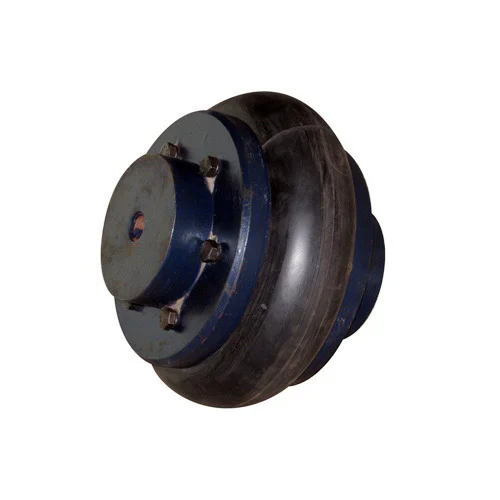
Common Rubber Materials Used in Manufacturing Rubber Couplings
Various rubber materials are used in the manufacturing of rubber couplings, each chosen based on its specific properties and the intended application:
- Neoprene: Known for its oil and chemical resistance, neoprene rubber is used in couplings that require durability and resistance to harsh environments.
- Nitrile: Nitrile rubber offers excellent oil and fuel resistance, making it suitable for applications in machinery that involve contact with lubricants.
- Natural Rubber: Natural rubber provides good elasticity and flexibility, making it suitable for couplings requiring high levels of shock and vibration absorption.
- EPDM: Ethylene Propylene Diene Monomer (EPDM) rubber offers good resistance to weather, ozone, and aging, making it suitable for outdoor or high-temperature applications.
- Polyurethane: Polyurethane rubber offers high abrasion resistance and can handle higher load capacities, making it suitable for heavy-duty applications.
The choice of rubber material depends on factors such as the operating environment, chemical exposure, temperature range, flexibility requirements, and load conditions. Engineers select the appropriate rubber material to ensure the coupling’s performance and longevity in specific applications.
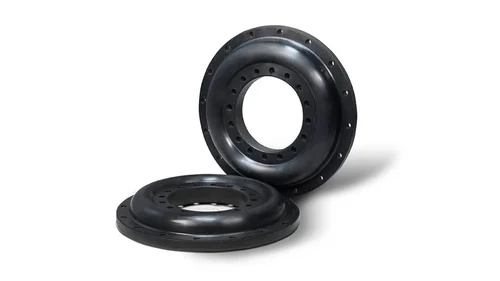
Role of Rubber Flexibility in Accommodating Misalignment
Rubber couplings are designed with a flexible element, usually made of elastomers, that plays a crucial role in accommodating misalignment between connected shafts. The flexibility of the rubber element allows it to deform and absorb angular, axial, and radial misalignments, providing several benefits:
1. Angular Misalignment: When the input and output shafts are not perfectly aligned in terms of angle, the rubber element can flex and twist, allowing the coupling to transmit torque even when the axes are not parallel.
2. Axial Misalignment: Axial misalignment occurs when the shafts move closer together or farther apart along their axis. The rubber element can compress or extend, adjusting the distance between the shafts without hindering torque transfer.
3. Radial Misalignment: Radial misalignment refers to the offset between the centers of the shafts. The rubber element can bend in response to radial displacement, ensuring that the coupling remains operational while accommodating the offset.
This flexibility not only enables the rubber coupling to handle misalignment but also helps prevent excessive stress on the connected machinery. By absorbing shock loads and distributing forces, the rubber element reduces wear and tear on components and minimizes the risk of premature failure.
In essence, the rubber’s flexibility in the coupling acts as a buffer against misalignment-induced stresses, contributing to smoother operation, improved longevity, and reduced maintenance in mechanical systems.


editor by CX 2024-04-15
China best Flexible Coupling Rubber Spider Insert Lovejoy L-Type Hydraulic Jaw Coupler L Series Jaw Type Flexible Coupling
Product Description
Flexible Coupling Rubber Spider Insert Lovejoy L-type Hydraulic Jaw Coupler L series jaw type flexible coupling
Features
1. Split in half design for simple installation, maintaining free
2. High misalignment capacity
3. Facility protection for a twirl, twist, impact, and abrasion
4. No lubrication for polyurethane flex element
5. Available for bore-to-size hubs and taper lock bushes
6. Low noise
Product Description
|
Size |
Type |
A |
B |
D |
E |
Standard |
Metric bore |
Inch bore |
||
|
bore |
Min |
Max |
Min |
Max |
||||||
| L035 |
1 |
16 |
20.5 |
6.6 |
/ |
3 |
3 |
8 |
1/8″ |
3/8″ |
|
L050 |
1 |
28 |
43.2 |
15.6 |
/ |
6 |
6 |
15 |
3/16″ |
5/8″ |
|
L070 |
1 |
35 |
50.8 |
19 |
/ |
9 |
9 |
19 |
3/16″ |
3/4″ |
|
L075 |
1 |
45 |
54.7 |
21 |
/ |
9 |
9 |
25 |
3/16″ |
1″ |
|
L090 |
1 |
54 |
54.7 |
21 |
/ |
9 |
9 |
28 |
3/16″ |
1 1/8″ |
|
L095 |
1 |
54 |
63.7 |
25.5 |
/ |
9 |
9 |
28 |
3/8″ |
1 1/8″ |
|
L099 |
1 |
64.5 |
72.5 |
27 |
/ |
12 |
12 |
35 |
7/16″ |
1 3/8″ |
|
L100 |
1 |
64.5 |
88.5 |
35 |
/ |
12 |
12 |
35 |
7/16″ |
1 3/8″ |
|
L110 |
1 |
85 |
108 |
43 |
/ |
15 |
15 |
48 |
1/2″ |
1 7/8″ |
|
L150 |
1 |
96 |
115.4 |
45 |
/ |
15 |
15 |
48 |
5/8″ |
1 7/8″ |
|
L190 |
2 |
115 |
133.4 |
54 |
101.6 |
19 |
19 |
55 |
5/8″ |
2 1/4″ |
|
L225 |
2 |
127 |
153.4 |
64 |
108 |
19 |
19 |
65 |
3/4″ |
2 5/8″ |
Related Products
Company Profile
FAQ
Q: How to ship to us?
A: It is available by air, by sea, or by train.
Q: How to pay the money?
A: T/T and L/C are preferred, with different currencies, including USD, EUR, RMB, etc.
Q: How can I know if the product is suitable for me?
A: >1ST confirm drawing and specification >2nd test sample >3rd start mass production.
Q: Can I come to your company to visit?
A: Yes, you are welcome to visit us at any time.
Minimizing Resonance and Improving Machinery Performance with Rubber Couplings
A rubber coupling can play a significant role in minimizing resonance and enhancing the overall performance of machinery by effectively damping vibrations and reducing the risk of resonance-related issues. Resonance is a phenomenon where a mechanical system’s natural frequency matches the frequency of external vibrations, leading to amplified oscillations and potential damage.
The following ways illustrate how rubber couplings contribute to minimizing resonance and improving machinery performance:
- Vibration Damping: Rubber couplings utilize the inherent damping properties of elastomers to absorb and dissipate vibrations generated during operation. These vibrations can include those caused by unbalanced loads, eccentricities, or other disturbances. By damping these vibrations, rubber couplings prevent them from building up and causing resonance.
- Vibration Isolation: Rubber couplings act as isolators by decoupling the connected components from each other. This isolation prevents vibrations from being transmitted directly from one component to another, thereby reducing the potential for resonance to occur.
- Misalignment Compensation: Rubber couplings can accommodate misalignments between shafts, which often contribute to excessive vibrations. By allowing a certain degree of misalignment, the coupling prevents additional forces that could trigger resonance.
- Reduced Stiffness: The flexibility of the elastomer elements in rubber couplings can reduce the overall stiffness of the system. A lower stiffness helps avoid the amplification of resonance by allowing some deformation of the coupling under varying loads and conditions.
- Dynamic Absorption: Rubber couplings are effective at absorbing dynamic loads, including sudden shocks or impacts. These dynamic events can excite resonance, and the coupling’s ability to absorb and disperse such forces helps prevent resonance-related issues.
By effectively dampening vibrations, isolating components, and accommodating misalignments, rubber couplings can help minimize the risk of resonance-related problems. Engineers and designers must carefully select the appropriate rubber coupling type, elastomer material, and design to match the specific machinery and operating conditions, thereby ensuring improved machinery performance and longevity.
Comparison of Rubber Couplings with Other Flexible Coupling Types
Rubber couplings, elastomeric couplings, and disc couplings are all flexible coupling options used in various mechanical systems. Here’s a comparison of rubber couplings with these alternatives:
Rubber Couplings:
- Transmit torque while damping vibrations through the flexibility of rubber elements.
- Provide good misalignment compensation and shock absorption.
- Relatively simple construction and cost-effective.
- Effective in reducing noise and vibration in applications.
- Suitable for moderate to high torque applications with moderate misalignment.
Elastomeric Couplings:
- Similar to rubber couplings, utilize elastomeric materials for flexibility and vibration damping.
- Offer higher torque capacity and stiffness compared to rubber couplings.
- Provide better misalignment compensation and torsional stiffness.
- Wider range of sizes and configurations for various applications.
- Commonly used in pumps, compressors, and other machinery.
Disc Couplings:
- Use a series of metal discs to transmit torque and accommodate misalignment.
- Offer high torsional stiffness and accuracy in torque transmission.
- Can handle higher speeds and torque compared to rubber or elastomeric couplings.
- Require precision in manufacturing and installation.
- Used in applications requiring high precision and minimal backlash.
When choosing between these flexible coupling types, considerations such as torque requirements, misalignment compensation, torsional stiffness, and application-specific needs play a significant role in making the appropriate selection. Each type has its advantages and limitations, making it important to assess the specific requirements of the machinery system.
Main Advantages of Using Rubber Couplings in Industrial Applications
Rubber couplings offer several key advantages when used in industrial applications. These advantages make them a popular choice for various industries and mechanical systems:
- Misalignment Tolerance: Rubber couplings can accommodate angular, parallel, and axial misalignments between connected shafts, reducing the need for precise alignment during installation and operation.
- Vibration Damping: The rubber elements of these couplings absorb and dampen vibrations, minimizing the transmission of vibrations and shocks to other components. This helps prevent damage, wear, and noise generation.
- Shock Absorption: In systems where sudden shocks or impacts occur, rubber couplings absorb and cushion the impact, protecting connected components from damage.
- Noise Reduction: The ability to dampen vibrations also contributes to noise reduction, creating quieter operation environments for machinery and equipment.
- Equipment Protection: Rubber couplings protect sensitive equipment from excessive loads, vibrations, and shocks, enhancing the longevity and reliability of the system.
- Cost-Effectiveness: Compared to some other coupling types, rubber couplings are generally cost-effective to manufacture, purchase, and maintain.
- Easy Installation: The flexibility and design of rubber couplings make them relatively easy to install without the need for specialized tools or complex procedures.
- Minimal Maintenance: Rubber couplings require minimal maintenance and lubrication, reducing downtime and maintenance costs.
- Wide Range of Applications: Rubber couplings are versatile and find applications in various industries, including automotive, power generation, pumps, conveyors, and more.
In summary, the main advantages of using rubber couplings in industrial applications include their ability to tolerate misalignment, dampen vibrations, absorb shocks, reduce noise, protect equipment, cost-effectiveness, easy installation, low maintenance requirements, and suitability for a wide range of applications.
editor by CX 2023-10-20
L100 Custom made in China – replacement parts – in Najaf Iraq Lovejoy L Coupling with top quality

We – EPG Group the bigge EPT gearbox & motors , vee pulleys, timing pulleys, couplings and gears manufacturing unit in China with 5 different branches. For much more details: Cellular/whatsapp/telegram/Kakao us at: 0086~13083988828 13858117778 0571 88828
L100 Lovejoy L coupling
AVAILAB EPT Dimensions&colon 35&comma fifty&comma 70&comma 75&comma 90&comma 95&comma 99&comma 100&comma one hundred ten&comma one hundred fifty&comma a hundred ninety&comma 225
L100 Lovejoy L coupling &commaL COUPLING &commaL Type FLEXIB EPT JAW COUPLING
one&time period Content &colon EPT EPT iron GG25
two&period of time Good stability
three&period of time Easy to maintain
four&periodOEM
L coupling have underneath benefit &colon
one&period It is simple to preserve &commano need the instrument can install
two&period Can undertake substantial torque
three&period Have the excellent buffer &interval
Features&colon
Cost-effective and functional employing
Easy pulling out
Easy building and light-weight weight
NBR rubber with outstanding resistance to oil and drugs
Bare minimum area
No lubrication
L coupling parameters and info &colon
| Coupling kind | Rated torque | HP-100PRM | |||||||
| In-Lbs&time period | Horsepower Potential at Varying Speed&lparRPM&rpar | Max Bore | |||||||
| Rubber | Hytrel | Rubber | Hytrel | three hundred | 1200 | 1800 | 3600 | ||
| L-035 | 3&period5 | &period0056 | &period017 | &period067 | &period1 | &period2 | 3&sol8 | ||
| L-050 | 25&period2 | &period04 | &period12 | &period48 | &period72 | 1&period44 | 5&sol8 | ||
| L-070 | 37&period8 | &period06 | &period18 | &period72 | 1&period08 | 2&period16 | 3&sol4 | ||
| L-075 | seventy five&period6 | &period12 | &period36 | 1&period44 | two&period16 | 4&period32 | 7&sol8 | ||
| L-090 | 126 | &period2 | &period6 | two&period4 | 3&period6 | 7&period2 | 7&sol8 | ||
| L-095 | 176 | &period28 | &period84 | 3&period36 | 5&period04 | ten&period8 | 1-1&sol8 | ||
| L-099 | 265 | &period42 | 1&period26 | five&period04 | seven&period56 | fifteen&period1 | 1-3&sol16 | ||
| L-a hundred | 278 | &period6 | 1&period8 | 7&period2 | ten&period8 | 21&period6 | 1-3&sol8 | ||
| L-a hundred and ten | 693 | 2079 | one&period1 | 3&period3 | three&period3 | 13&period2 | 19&period8 | 39&period6 | 1-5&sol8 |
| L-150 | 1071 | 3213 | one&period7 | five&period1 | 5&period1 | twenty&period4 | 30&period6 | sixty one&period2 | 1-7&sol8 |
We – EPG Team the bigge EPT gearbox & motors , vee pulleys, timing pulleys, couplings and gears manufacturing facility in China with 5 various branches. For far more details: Mobile/whatsapp/telegram/Kakao us at: 0086~13083988828 13858117778 0571 88828 The use of first products manufacturer’s (OEM) element numbers or trademarks , e.g. CASE® and John Deere® are for reference needs only and for indicating solution use and compatibility. Our company and the listed replacement areas contained herein are not sponsored, authorized, or made by the OEM.